Introduction
Moving into a new home is a significant milestone that marks the beginning of a new chapter in life. In Hindu tradition, entering a new house at an auspicious time is an important part of the Gruhapravesham ceremony. The auspicious date and time selected for this occasion is known as Gruhapravesham Muhurtham or Griha Pravesh Muhurat.
Choosing the right Muhurtham is traditionally believed to help begin life in a new home with prayers for peace, prosperity, happiness, good health, and harmony. The selection of the Muhurtham is generally based on the Hindu Panchangam and may involve factors such as Tithi, Nakshatra, Vara, Yoga, Karana, and Lagna.
At Veda Gayathri, we share information about Hindu traditions, Poojas, festivals, auspicious occasions, Panchangam, and spiritual practices. This guide explains how Gruhapravesham Muhurtham is traditionally selected, which factors are considered, what periods may be preferred or avoided, and how families can prepare for their housewarming ceremony.
What Is Gruhapravesham Muhurtham?
Gruhapravesham Muhurtham refers to the auspicious date and time selected for entering a new home and performing the associated housewarming rituals.
The word “Gruha” means home or house, while “Pravesham” means entry. Muhurtham refers to an auspicious period selected for beginning an important activity.
In traditional Hindu practice, the main house entry may be planned according to a particular Muhurtham rather than simply choosing a convenient date. The family may perform Ganesh Pooja, Vastu Pooja, Homam, Kalasha-related rituals, and other ceremonies around this time.
The exact procedure and criteria used to determine the Muhurtham can vary according to regional customs, family traditions, and the Panchangam followed by the family.
Why Is Gruhapravesham Muhurtham Important?
A new house is more than a physical structure. For many families, it represents a new beginning, a place where relationships, celebrations, prayers, and everyday life will continue for years.
Traditionally, selecting an auspicious Gruhapravesham Muhurtham is considered a way of beginning this new chapter at a spiritually favorable time. Families may seek blessings for prosperity, peace, health, protection, and harmony.
The Muhurtham also provides a specific time for the main house-entry ritual. Once the date and time are finalized, the family can organize the priest, Pooja materials, decorations, food, guests, and other arrangements around the ceremony.
How Is Gruhapravesham Muhurtham Selected?
Gruhapravesham Muhurtham is traditionally determined using the Hindu Panchangam. A priest or astrologer may examine different calendar elements before recommending a suitable date and time.
Some of the important factors considered include:
- Tithi
- Nakshatra
- Vara or weekday
- Yoga
- Karana
- Lagna
- Planetary considerations
- Regional Panchangam
- Family traditions
- Birth details of the house owner, where applicable
These factors are considered together rather than relying on a single element. This is why a date that appears auspicious in a general calendar may not necessarily be the preferred Muhurtham for every family.
What Is Panchangam and Why Is It Used for Gruhapravesham?
The Hindu Panchangam is a traditional calendar used to determine dates, festivals, religious occasions, and auspicious timings.
The word Panchangam refers to five important components:
- Tithi
- Vara
- Nakshatra
- Yoga
- Karana
These elements are used in traditional Muhurtham calculations for various activities, including weddings, housewarming ceremonies, naming ceremonies, and other important occasions.
For Gruhapravesham, the Panchangam helps identify suitable dates and time periods based on traditional astrological and calendrical considerations.
Since Panchangams can differ by region and calculation method, families should use the Panchangam traditionally followed in their area or community.
What Is Tithi and Why Does It Matter?
Tithi refers to a lunar day in the Hindu calendar. There are traditionally 30 Tithis in a lunar month, divided between Shukla Paksha and Krishna Paksha.
When selecting Gruhapravesham Muhurtham, certain Tithis may traditionally be preferred while others may be avoided depending on the tradition being followed.
The Tithi is not considered independently. Other Panchangam elements such as Nakshatra, weekday, Yoga, Karana, and Lagna may also be examined before finalizing the Muhurtham.
Because different traditions can follow different rules, it is advisable to confirm the suitable Tithi with a priest who follows the family’s customary Panchangam.
What Is Nakshatra and How Does It Affect Gruhapravesham Muhurtham?
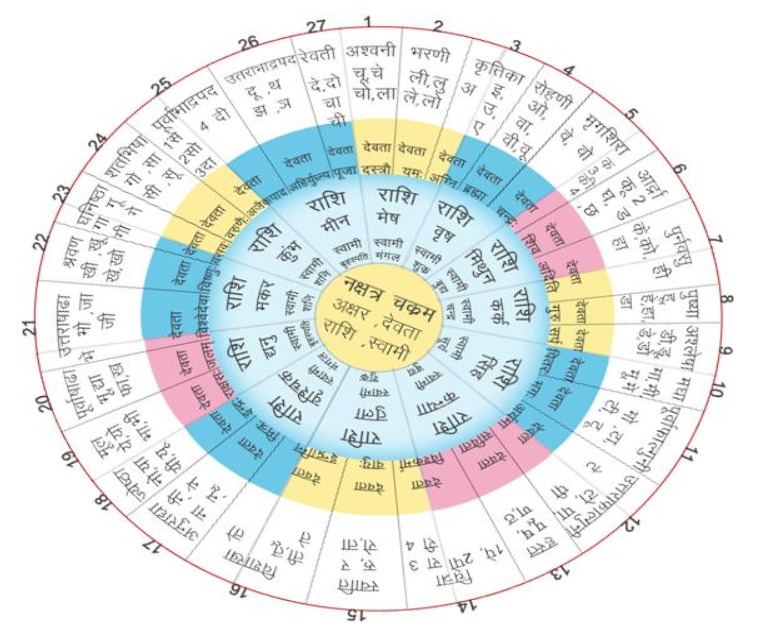
Nakshatra refers to the lunar constellation associated with a particular time. Hindu astrology traditionally recognizes 27 Nakshatras.
Nakshatra is one of the important factors considered when choosing an auspicious Muhurtham. Certain Nakshatras are traditionally regarded as favorable for activities connected with establishing a home.
The selected Nakshatra may be considered along with Tithi, Lagna, weekday, and other factors.
In some traditions, the Nakshatra associated with the house owner’s birth may also be considered when determining a suitable time. The specific approach depends on the priest and the family’s astrological tradition.
How Does the Weekday Affect Gruhapravesham Muhurtham?
The weekday, known as Vara, is another component considered in traditional Muhurtham selection.
Different weekdays may have different associations in Hindu astrology. A priest may consider the weekday together with the Tithi, Nakshatra, and other Panchangam elements before recommending a date.
Rather than selecting a date simply because it falls on a particular weekday, the complete Muhurtham should be evaluated.
This is especially important because the same weekday can have different suitable or unsuitable time periods depending on the date and location.
What Is Lagna and Why Is It Considered?
Lagna refers to the ascendant or rising sign at a particular time and location. It changes approximately every two hours, which is why the exact timing of a ceremony can be important in traditional Muhurtham calculations.
For Gruhapravesham, the priest may identify a suitable Lagna during which the main house-entry ritual should take place.
The location of the house is relevant because sunrise, sunset, planetary positions, and other calculations depend on geographical location and local time.
This is one reason why a Gruhapravesham Muhurtham calculated for one city should not automatically be applied to another city without verification.
Which Months Are Traditionally Considered Suitable for Gruhapravesham?
Traditional Hindu calendars identify certain periods as more suitable for housewarming ceremonies. Depending on the regional tradition, months such as Magha, Phalguna, Vaishakha, and Jyeshtha are often discussed as favorable periods for Griha Pravesh.
However, the exact suitability of a month can differ according to the Panchangam and local tradition.
A month alone does not determine the Muhurtham. The specific Tithi, Nakshatra, weekday, Lagna, and other considerations should also be checked.
Therefore, families planning Gruhapravesham should confirm the complete date and time rather than selecting a date only because the month is traditionally considered favorable.
Are There Periods Traditionally Avoided for Gruhapravesham?
Some Hindu traditions avoid certain periods for auspicious ceremonies. These may include particular inauspicious periods or times associated with specific religious or astrological considerations.
Depending on the tradition, families may also consider periods such as certain solar transitions, major planetary events, or other restricted periods when planning Gruhapravesham.
Practices differ significantly across regions and communities. Therefore, a general list of “do not perform Gruhapravesham during this period” should not be treated as universal.
A local priest can check the Panchangam for the year, location, and family’s tradition and suggest suitable dates.
Does the House Owner’s Birth Details Matter?
In some traditional astrological practices, the birth details of the house owner may be considered while selecting an auspicious Muhurtham.
The priest or astrologer may examine details such as:
- Date of birth
- Time of birth
- Place of birth
- Janma Nakshatra
- Rashi
These details may be used along with the Panchangam to identify a suitable time.
However, this is not handled identically in every tradition. Some families select the Muhurtham primarily based on the Panchangam and ceremony requirements, while others incorporate individual birth-chart considerations.
Families should follow the method traditionally practiced in their community.

Why Is the Location of the House Important?
The location of the new home is an important practical factor when calculating the Gruhapravesham Muhurtham.
Sunrise, sunset, planetary positions, and local time can differ between locations. Therefore, a Muhurtham calculated for Hyderabad, for example, may not automatically be applicable to a house in another city or country.
When consulting a priest, provide the exact location of the new house so that the local Panchangam and timings can be considered.
This is particularly important for families moving to another state or country.
What Is the Difference Between Gruhapravesham Date and Muhurtham?
The Gruhapravesham date refers to the calendar date chosen for the housewarming ceremony, while the Muhurtham refers to the specific auspicious time period on that date.
For example, a particular day may be selected as the Gruhapravesham date, but the actual house entry may need to take place during a specific period within that day.
Therefore, families should record both the date and the exact Muhurtham time provided by their priest.
The ceremony may begin before the Muhurtham, while the main house entry is performed during the specified auspicious period.
How Early Should You Select Gruhapravesham Muhurtham?
It is advisable to start planning the Gruhapravesham ceremony well in advance. Popular auspicious dates may be convenient for many families, and priests may have multiple ceremonies scheduled on the same day.
Early planning allows enough time to:
- Consult a priest
- Select the Muhurtham
- Complete housework
- Purchase Pooja materials
- Arrange decorations
- Prepare invitations
- Plan food
- Invite relatives
- Organize transportation
- Prepare the kitchen
Starting early also provides flexibility if the first selected date becomes difficult due to construction delays or other practical circumstances.
How to Choose Gruhapravesham Muhurtham Step by Step
The first step is to confirm that the house is ready for occupation. Major construction, electrical work, plumbing, painting, and other essential work should ideally be completed.
The next step is to consult a priest or astrologer who can check the Panchangam and identify suitable dates.
After selecting possible dates, the Tithi, Nakshatra, weekday, Yoga, Karana, and Lagna can be examined according to the relevant tradition.
The location of the property should also be provided so that the timing can be calculated correctly.
Once the date and time are finalized, confirm the priest and begin organizing the Pooja materials, decorations, food, invitations, and other arrangements.
What Poojas Are Usually Performed During Gruhapravesham?
The rituals performed during Gruhapravesham can differ from one family to another. Common rituals may include Ganesh Pooja, Punyahavachanam, Kalasha Sthapana, Vastu Pooja, Navagraha Pooja, Homam, and other prayers.
Ganesh Pooja may be performed at the beginning to seek blessings for an auspicious ceremony.
Vastu Pooja may be performed as part of traditional prayers for the home and its occupants.
A Homam may also be included, depending on the family’s customs and the priest’s recommendations.
The main house entry is performed during the selected Gruhapravesham Muhurtham.
What Should Be Prepared Before the Gruhapravesham Muhurtham?
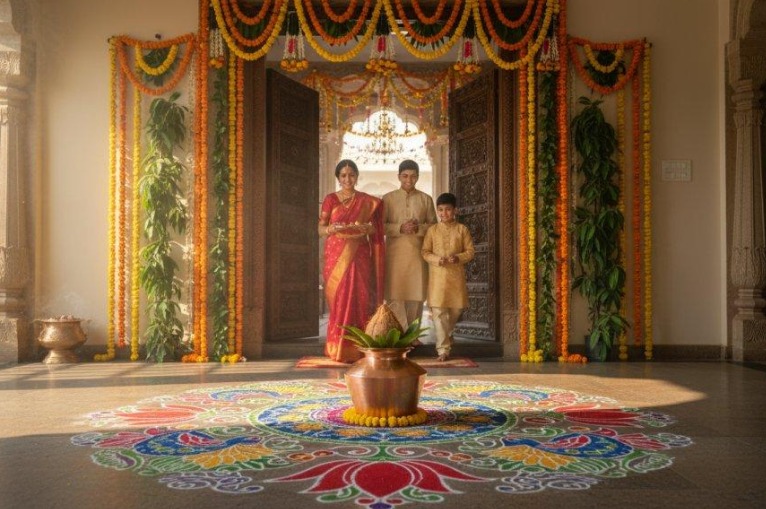
The house should be thoroughly cleaned before the ceremony. The entrance can be decorated with flowers, mango leaves, torans, Rangoli, or Muggu.
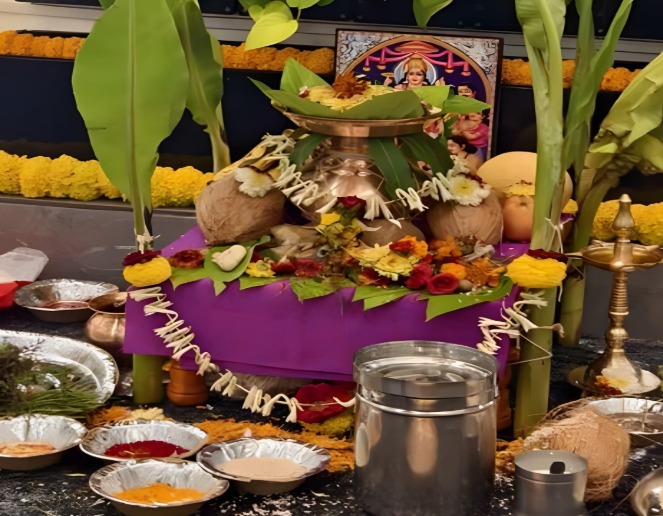
The Pooja area should be prepared and all required materials should be kept ready. Common items may include turmeric, kumkum, rice, flowers, fruits, coconut, Kalasha, mango leaves, lamps, incense, camphor, and other items specified by the priest.
The kitchen should also be ready if the family plans to perform the traditional milk-boiling ceremony.
It is helpful to keep all Pooja materials in one place so that the ceremony can proceed smoothly.
What Should the Family Do During the Muhurtham?
The family should follow the instructions provided by the priest during the ceremony. The main house entry should take place at the selected auspicious time.
Depending on family tradition, the family may enter the home carrying a Kalasha, coconut, lamp, rice, or other auspicious items.
The traditional milk-boiling ceremony may then be performed in the kitchen.
The exact sequence can differ according to the family’s regional and religious practices, so the priest conducting the ceremony should guide the family through each step.
Common Mistakes to Avoid When Choosing Gruhapravesham Muhurtham
One common mistake is selecting a date based only on an online list of auspicious dates. Such lists may not account for the location, family tradition, or specific Panchangam being followed.
Another mistake is confusing the Gruhapravesham date with the actual Muhurtham. The ceremony may have a particular date but a specific time for the main house entry.
Families should also avoid waiting until the last minute to confirm the priest or purchase Pooja materials.
Another important consideration is construction. If major work remains unfinished, it can make the ceremony difficult to conduct comfortably.
Finally, families should not assume that the same Muhurtham is suitable for every city or every family. Local Panchangam calculations and traditions should be considered.
Gruhapravesham Muhurtham Checklist
Planning a housewarming ceremony becomes easier when the important details are organized in advance.
Confirm the following before the ceremony:
- Gruhapravesham date
- Exact Muhurtham time
- Location of the house
- Priest availability
- Panchangam being followed
- Required Pooja rituals
- Pooja Samagri
- House cleaning
- Entrance decorations
- Rangoli or Muggu
- Kitchen preparation
- Milk-boiling arrangements
- Guest invitations
- Food and Prasadam
- Parking and seating arrangements
Keeping a written checklist can help the family avoid last-minute confusion.
Gruhapravesham Muhurtham for a Newly Constructed House
For a newly constructed house, Gruhapravesham is often planned once the property is substantially complete and ready for occupation.
The family should ideally complete important construction work before finalizing the ceremony. Electricity, water supply, plumbing, doors, windows, kitchen facilities, and basic safety requirements should be functional.
After confirming that the house is ready, the family can consult the priest and select an appropriate Muhurtham.
This allows the housewarming ceremony to be conducted in a clean and comfortable environment.
Gruhapravesham Muhurtham for a Purchased House
Families purchasing an existing property may also perform Gruhapravesham before moving in.
The house can be cleaned and necessary repairs or renovations can be completed before the ceremony. The family can then consult a priest about suitable purification and house-entry rituals.
The appropriate Muhurtham can be selected based on the Panchangam and the family’s customary practices.
Can Gruhapravesham Muhurtham Be Changed?
Sometimes practical circumstances such as construction delays, travel problems, family emergencies, or other unavoidable situations may make the originally selected Muhurtham difficult to follow.
In such situations, families that follow traditional practices generally consult their priest before changing the date or time.
The priest can identify another suitable Muhurtham based on the Panchangam and the family’s circumstances.
Rather than changing the time independently, it is better to discuss the situation with the person conducting the ceremony.
Frequently Asked Questions About Gruhapravesham Muhurtham
What is Gruhapravesham Muhurtham?
Gruhapravesham Muhurtham is the auspicious date and time traditionally selected for entering a new house and performing the main housewarming rituals.
How is Gruhapravesham Muhurtham calculated?
It is traditionally selected by examining Panchangam elements such as Tithi, Nakshatra, Vara, Yoga, Karana, and Lagna. Some traditions may also consider the house owner’s birth details.
Can I choose any date for Gruhapravesham?
Families following traditional Muhurtham practices generally select a date and time considered auspicious according to their Panchangam and customs.
Which months are considered good for Gruhapravesham?
Depending on regional traditions, months such as Magha, Phalguna, Vaishakha, and Jyeshtha are often considered favorable. The specific date and Muhurtham should still be checked.
Does the location of the house matter?
Yes. Traditional Muhurtham calculations can depend on the local time and geographical location of the house.
Does the house owner’s birth chart matter?
Some families and astrologers consider the house owner’s birth details while selecting a Muhurtham, while others primarily follow the Panchangam. The practice varies.
What is the difference between Griha Pravesh and Gruhapravesham?
Both terms refer to the traditional house-entry or housewarming ceremony. “Griha Pravesh” and “Gruhapravesham” are different forms of referring to the same general tradition.
Should the house be completely ready before Gruhapravesham?
Ideally, major construction and essential work should be completed so that the house is ready for occupation and the ceremony can be conducted comfortably.
Who can select the Gruhapravesham Muhurtham?
A priest or astrologer familiar with the family’s tradition and the relevant Panchangam can help select the Muhurtham.
Can the Gruhapravesham ceremony be performed without a Muhurtham?
Practices vary. Families that follow traditional Muhurtham customs generally select an auspicious time for the main house entry. Families should follow the practices appropriate to their tradition.
Conclusion
Choosing the right Gruhapravesham Muhurtham is an important part of planning a traditional Hindu housewarming ceremony. The process generally involves examining the Panchangam, Tithi, Nakshatra, weekday, Yoga, Karana, Lagna, and other traditional considerations.
The ideal Muhurtham is not necessarily the same for every family or every location. Regional Panchangams, family customs, the location of the property, and the guidance of a knowledgeable priest can all play a role in selecting the date and time.
Once the Muhurtham is finalized, families can focus on preparing the house, arranging the Pooja Samagri, decorating the entrance, organizing the ceremony, and inviting loved ones to share the occasion.
A carefully planned Gruhapravesham can make the transition into a new home a meaningful and memorable experience. Veda Gayathri provides information on Hindu Poojas, festivals, Panchangam, auspicious occasions, and traditional practices to help families understand and celebrate important milestones with devotion and awareness.