Introduction
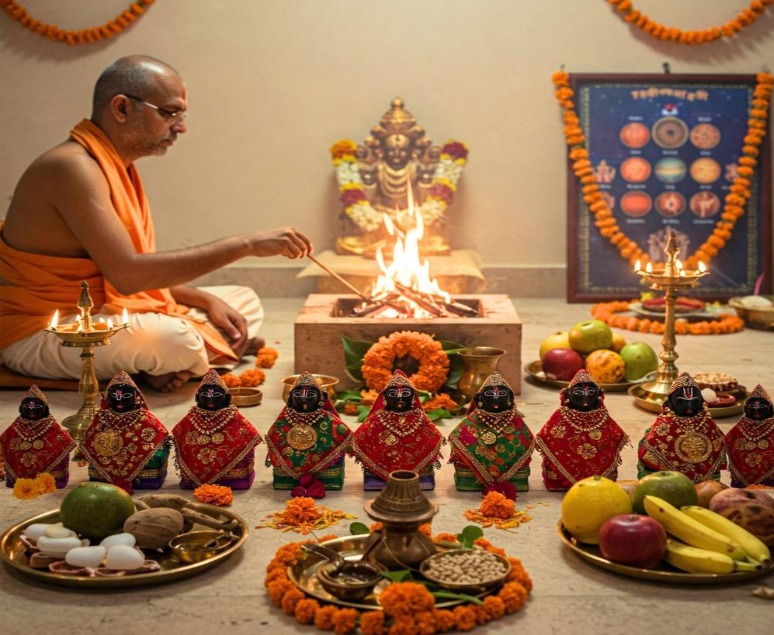
Marriage is considered one of the most important milestones in Hindu tradition. Families often perform various poojas and rituals before marriage to seek divine blessings and create a spiritually auspicious beginning for the couple. Navagraha Shanti for Marriage is one such traditional ritual performed to seek blessings associated with the nine celestial influences, known as the Navagrahas.
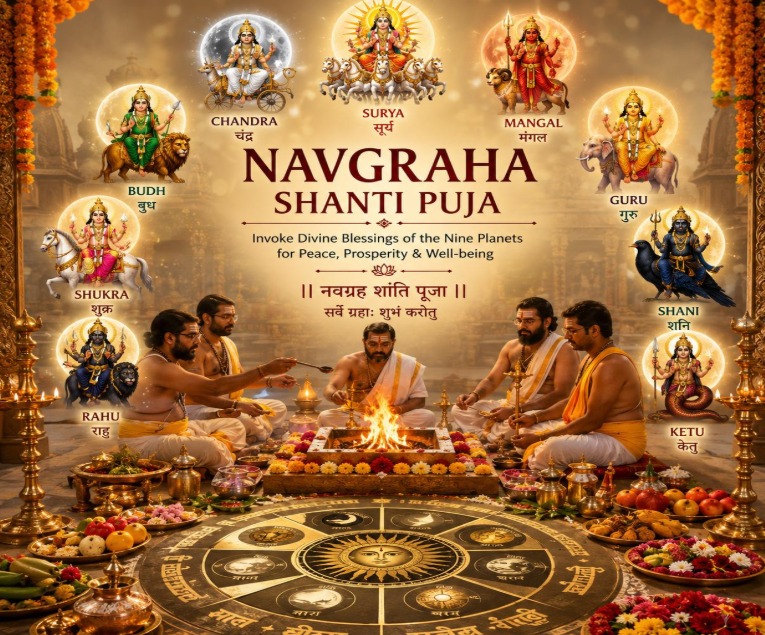
In Vedic astrology, the Navagrahas—Surya, Chandra, Mangala, Budha, Guru, Shukra, Shani, Rahu, and Ketu—are traditionally associated with different aspects of life. Navagraha Shanti is performed when a family wishes to undertake a traditional remedial ritual based on astrological considerations, including circumstances believed to affect marriage.
At Veda Gayathri, traditional poojas and Vedic rituals can be arranged according to the family’s requirements, customs, and guidance from qualified priests. Navagraha Shanti for Marriage can be performed as part of pre-wedding spiritual preparations when recommended according to the family’s tradition or astrological consultation.
This comprehensive guide explains the meaning, significance, procedure, suitable occasions, pooja materials, traditional associations, and frequently asked questions about Navagraha Shanti for Marriage.
What Is Navagraha Shanti for Marriage?
Navagraha Shanti is a traditional Hindu ritual performed to offer prayers to the nine Navagrahas and seek their auspicious blessings.
The word “Navagraha” means nine celestial influences, while “Shanti” refers to peace, harmony, or pacification. The ritual is traditionally performed with Vedic mantras, offerings, and prayers.
When performed in connection with marriage, the ceremony is intended as a spiritual observance before or around the wedding period. Families may consider Navagraha Shanti when an astrologer or priest recommends it based on the birth charts of the bride and groom.
The purpose is not to guarantee a particular outcome but to follow a traditional spiritual practice and seek blessings for the couple’s new journey.
Why Is Navagraha Shanti Performed Before Marriage?
According to traditional Hindu astrology, planetary positions in a person’s birth chart are considered when assessing different areas of life, including marriage.
If an astrologer identifies certain planetary combinations or concerns, the family may choose to perform appropriate traditional remedies such as Navagraha Shanti.
The ceremony may be performed with the intention of:
- Seeking divine blessings
- Promoting peace and harmony
- Beginning marriage-related rituals auspiciously
- Praying for the couple’s well-being
- Following family traditions
- Performing traditional remedies suggested after horoscope analysis
The exact reason for performing the ritual can differ from one family to another.
The Spiritual Significance of Navagraha Shanti
Navagraha Shanti is rooted in the traditional relationship between Hindu religious practices and Vedic astrology.
The nine Navagrahas are worshipped individually during the ceremony. Appropriate mantras, offerings, and rituals are performed according to the procedure followed by the priest.
For a couple preparing for marriage, the ceremony can provide a dedicated opportunity for prayer and reflection before beginning married life.
It also brings family members together and allows them to participate in an important spiritual occasion.
The Nine Navagrahas and Their Traditional Associations
Each of the nine Navagrahas has traditional associations in Hindu astrology and worship.
Surya – Sun
Surya, the Sun, is traditionally associated with vitality, authority, confidence, and strength.
During Navagraha worship, prayers to Surya are performed seeking blessings for strength, vitality, and positive energy.
Chandra – Moon
Chandra, the Moon, is traditionally associated with emotions, mental peace, sensitivity, and nurturing qualities.
In a marriage-related ritual, prayers to Chandra may be included as part of the traditional observance for emotional harmony and peace.
Mangala – Mars
Mangala, or Mars, is traditionally associated with courage, energy, determination, and physical strength.
Mars also has a significant place in traditional marriage astrology, particularly in discussions involving Manglik Dosha or Kuja Dosha.
Budha – Mercury
Budha, or Mercury, is traditionally associated with communication, intelligence, reasoning, and learning.
Communication and mutual understanding are important aspects of any relationship, making Mercury an important part of Navagraha worship.
Guru – Jupiter
Guru, or Jupiter, is traditionally associated with wisdom, knowledge, prosperity, spirituality, and guidance.
Jupiter is also traditionally regarded as an important planet in matters concerning marriage and family life, particularly in Vedic astrology.
Shukra – Venus
Shukra, or Venus, is traditionally associated with love, relationships, beauty, comforts, and marital happiness.
Because of these associations, Venus has an important role in traditional astrology concerning marriage.
Shani – Saturn
Shani, or Saturn, is traditionally associated with discipline, patience, responsibility, perseverance, and karma.
Prayers to Shani during Navagraha Shanti are traditionally performed as part of seeking peace and balance.
Rahu
Rahu is traditionally associated with desires, ambitions, unconventional experiences, and unexpected circumstances.
Rahu is one of the two lunar nodes and is included in Navagraha worship.
Ketu
Ketu, the other lunar node, is traditionally associated with spirituality, detachment, introspection, and transformation.
Ketu is also worshipped as part of the nine Navagrahas.
Navagraha Shanti and Marriage Horoscope
Horoscope matching is a traditional practice followed by many Hindu families before marriage.
Depending on the family’s beliefs and customs, an astrologer may examine the birth charts of the bride and groom for various factors.
These may include:
- Nakshatra
- Rashi
- Gana
- Yoni
- Nadi
- Graha Maitri
- Bhakoot
- Mangal or Kuja Dosha
- Planetary positions
- Dasha periods
If particular planetary combinations are considered concerning according to the astrologer’s interpretation, the family may be advised to perform Navagraha Shanti or another specific remedy.
It is important to remember that astrological interpretations can vary between practitioners and traditions.
What Is Manglik Dosha or Kuja Dosha?
One of the reasons families sometimes consider Navagraha-related remedies before marriage is Manglik Dosha, also known as Kuja Dosha.
In traditional Vedic astrology, Manglik Dosha is associated with certain placements of Mars in a birth chart.
Different astrological traditions use different methods to determine and interpret this condition. Some astrologers also consider cancellation or mitigating factors.
Therefore, families should consult a qualified practitioner if they wish to understand a specific horoscope rather than assuming that the presence of Mars in a particular house automatically indicates a marriage problem.
Navagraha Shanti may sometimes be recommended as part of a traditional remedial approach.
When Should Navagraha Shanti Be Performed for Marriage?
There is no single universally followed date for Navagraha Shanti.
The timing may depend on:
- Birth charts
- Astrological recommendation
- Wedding Muhurtham
- Tithi
- Nakshatra
- Vara
- Family tradition
- Priest’s guidance
Some families perform the ritual before finalizing the wedding, while others perform it during the pre-wedding period.
If a particular planetary remedy has been recommended, the priest or astrologer can suggest an appropriate date and time.
Navagraha Shanti Before Wedding
Performing Navagraha Shanti before the wedding is a traditional way for families to begin the marriage celebrations with prayers and devotional observances.
The ritual may be conducted several days or weeks before the wedding, depending on the circumstances.
This arrangement can be convenient when the family wants to complete the ritual separately from the busy wedding schedule.
The ceremony may involve both families, particularly when the ritual has been recommended based on the horoscopes of the bride and groom.
Navagraha Shanti During the Wedding Period
Some families prefer to perform Navagraha Shanti close to the wedding date.
This may allow the couple and their families to complete the ritual as part of the overall wedding schedule.
However, the exact timing should be determined based on the family’s tradition and priest’s guidance rather than following a general date found online.
Navagraha Shanti Puja Procedure
The exact procedure varies according to the priest, sampradaya, family tradition, and purpose of the ritual.
A general ceremony may include the following stages.
1. Preparation of the Pooja Area
The pooja space is cleaned and arranged before the ceremony.
A suitable platform or altar is prepared for the Navagraha worship.
Traditional decorations such as flowers, rangoli, mango leaves, and lamps may be used.
2. Ganapati Puja
The ceremony may begin with prayers to Lord Ganesha.
Ganapati is traditionally worshipped at the beginning of many Hindu religious ceremonies.
The family seeks blessings for the smooth completion of the pooja.
3. Sankalpam
The priest guides the participants through the Sankalpam, the sacred statement of intention for performing the ritual.
The relevant details are traditionally recited as part of the Sankalpam.
This formally establishes the purpose of the pooja.
4. Kalasha Sthapana
A sacred Kalasha may be established as part of the ritual.
The Kalasha is commonly decorated with:
- Mango leaves
- Coconut
- Turmeric
- Kumkum
- Flowers
The priest performs the associated prayers and invokes divine presence according to the traditional procedure.
5. Navagraha Avahanam
The priest invokes the nine Navagrahas through appropriate mantras and rituals.
Each planetary deity is worshipped individually.
The sequence may vary depending on the tradition followed.
6. Navagraha Mantra Chanting
Specific mantras associated with the Navagrahas may be chanted during the ceremony.
The couple and family members participate according to the priest’s instructions.
Mantra chanting forms an important spiritual component of the ceremony.
7. Offerings to the Navagrahas
Traditional offerings are made to the planetary deities.
These may include:
- Flowers
- Fruits
- Grains
- Water
- Lamps
- Incense
- Naivedyam
- Other items prescribed by the priest
The exact offerings may differ for each Navagraha.
8. Homa or Homam
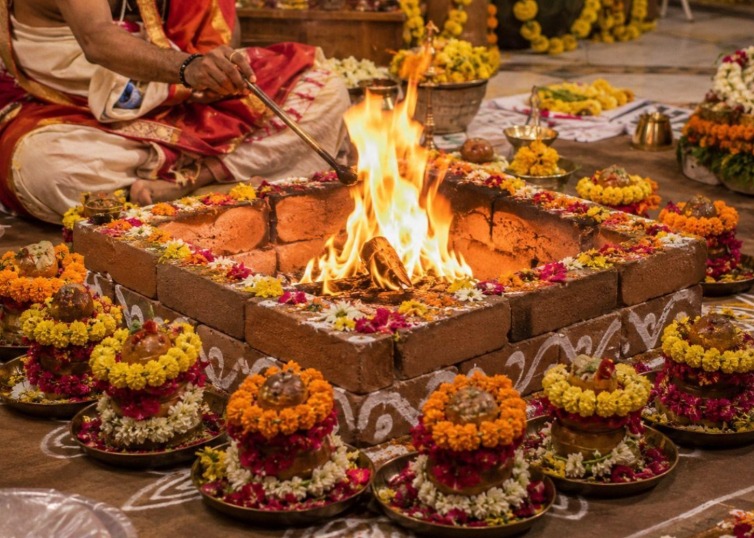
Depending on the form of Navagraha Shanti being performed, a Navagraha Homa may be included.
Sacred offerings are made into the fire while appropriate mantras are recited.
The fire ritual is conducted by the priest according to the prescribed procedure.
9. Purnahuti
If a homam is performed, the ceremony may conclude with Purnahuti, the final offering into the sacred fire.
This represents the completion of the homam.
10. Aarti and Blessings
The ceremony may conclude with Aarti and prayers.
The bride and groom, along with their family members, receive blessings from the priest and elders.
Pooja Items Required for Navagraha Shanti
The exact list of materials depends on the specific procedure.
Commonly required items may include:
- Turmeric
- Kumkum
- Rice
- Flowers
- Fruits
- Coconut
- Betel leaves
- Betel nuts
- Mango leaves
- Kalasha
- Water
- Ghee
- Sesame seeds
- Navadhanyas
- Incense
- Camphor
- Cotton wicks
- Lamps
- Sandalwood
- Naivedyam
- Homa materials
Some Navagraha rituals may require specific grains or offerings associated with individual planets.
The priest should provide the final materials list before the ceremony.
What Is Navadhanyas in Navagraha Puja?
Navadhanyas refers to nine types of grains traditionally associated with the nine Navagrahas.
They may be used as offerings during certain Navagraha rituals.
The specific grains and their associations can vary according to regional and ritual traditions.
Navadhanyas are often included when performing more elaborate Navagraha Pooja or Homa.
Role of Navagraha Homa in Marriage-Related Pooja
Navagraha Homa is a fire ritual performed as part of certain forms of Navagraha worship.
During the Homa, offerings are made into the sacred fire while the priest recites appropriate mantras.
When performed in connection with marriage, the ritual is traditionally intended to seek blessings and peace in relation to planetary influences identified through astrological consultation.
The Homa may be performed separately or as part of a larger Navagraha Shanti ceremony.
Traditional Benefits Associated With Navagraha Shanti
Navagraha Shanti is traditionally associated with several spiritual intentions.
Seeking Planetary Blessings
The ceremony provides an opportunity to worship all nine Navagrahas.
Promoting Peace and Harmony
The word Shanti represents the traditional intention of seeking peace and balance.
Supporting Marriage-Related Prayers
Families may perform the ritual when preparing for marriage and seeking blessings for the couple.
Following Traditional Remedies
The ceremony may be recommended as a traditional remedy after horoscope consultation.
Spiritual Preparation
The ritual provides a devotional setting for the couple and their families before marriage.
These are traditional religious and astrological beliefs, rather than scientifically established effects.
Navagraha Shanti for Delayed Marriage
Some families consult astrologers when a marriage has been delayed for a longer period than expected.
If the astrologer identifies particular planetary factors according to their interpretation, they may recommend traditional remedies such as Navagraha Shanti.
The ritual is then performed as a form of prayer and religious observance.
Families should understand that marriage timing depends on many real-world factors, and a ritual should not be considered a guaranteed method for changing an outcome.
Navagraha Shanti for Marriage Compatibility
Compatibility is an important consideration in many traditional Hindu marriage practices.
Families may examine the horoscopes of the bride and groom before marriage.
If an astrologer recommends a planetary remedy based on their interpretation of the charts, Navagraha Shanti may be performed.
The ritual can be viewed as a devotional practice alongside the family’s broader considerations about marriage.
Who Can Perform Navagraha Shanti?
Navagraha Shanti is generally conducted by a priest trained in the relevant Vedic ritual procedures.
The priest may guide:
- Bride and groom
- Parents
- Family members
- Other participants
The exact level of participation depends on the type of ritual and the family’s tradition.
For a marriage-related ceremony, it is useful to discuss the couple’s horoscope details and purpose of the ritual with the priest beforehand.
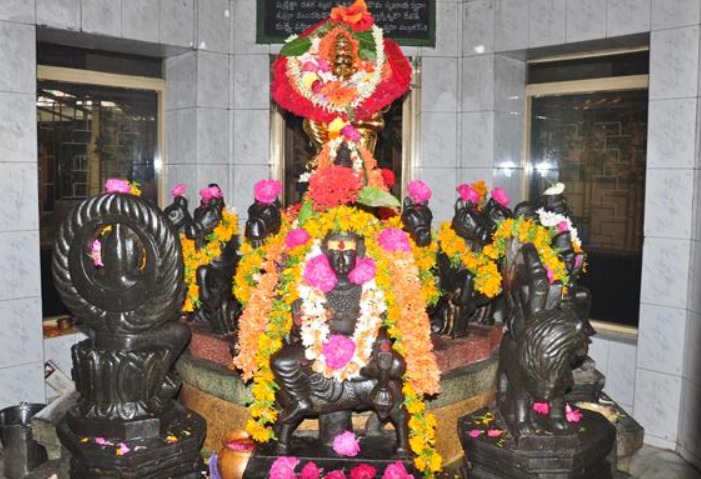
Navagraha Shanti at a Temple
Some families prefer performing Navagraha-related rituals at temples traditionally associated with planetary worship.
A temple-based ceremony can provide an established religious environment and access to traditional facilities.
Families should check the temple’s specific procedures, booking requirements, and available pooja services before planning the ceremony.
Navagraha Shanti at a Wedding Venue
If the wedding venue has sufficient space and allows religious ceremonies, Navagraha Shanti may sometimes be arranged there.
This can be convenient for families who want to complete multiple wedding-related rituals at the same location.
The venue should have suitable arrangements for:
- Pooja
- Priest seating
- Couple seating
- Kalasha setup
- Homa, if included
- Fire safety
- Required ritual materials
How to Prepare for Navagraha Shanti for Marriage
Proper preparation helps the ceremony proceed smoothly.
Consult the Priest or Astrologer
Discuss why the ritual is being performed and whether any specific planetary remedy is recommended.
Confirm the Date and Time
Select the timing according to the family’s tradition and priest’s guidance.
Prepare the Pooja Materials
Collect all required materials in advance.
Prepare the Couple
The bride and groom should understand the basic purpose and procedure of the ceremony.
Arrange the Pooja Space
Keep the space clean and suitable for the ritual.
Inform Family Members
Tell participating family members about the date and timing beforehand.
Important Things to Remember Before Navagraha Shanti
Families planning the ceremony should remember that practices can differ significantly.
Follow Your Family Tradition
There may be specific procedures followed by your family or community.
Consult a Qualified Priest
The priest can explain the correct procedure and materials.
Do Not Assume Every Dosha Requires the Same Remedy
Astrological interpretations depend on the complete birth chart and the tradition used.
Prepare the Materials in Advance
A complete materials checklist prevents last-minute difficulties.
Understand the Spiritual Purpose
Navagraha Shanti is fundamentally a traditional religious observance and should be approached with devotion and understanding.
Navagraha Shanti and Modern Wedding Planning
Modern weddings often combine traditional rituals with contemporary celebrations.
Couples may have:
- Engagement
- Pre-wedding celebrations
- Traditional poojas
- Mehendi
- Haldi
- Sangeet
- Wedding ceremony
- Reception
Navagraha Shanti can be incorporated into the schedule according to the family’s preferences.
Families may choose to keep the ceremony private or invite close relatives to participate.
Why Choose Veda Gayathri for Navagraha Shanti?
At Veda Gayathri, traditional Hindu poojas and Vedic rituals can be arranged according to the family’s requirements and customary practices.
For a marriage-related Navagraha Shanti, families can discuss the purpose of the ceremony, preferred location, timing, and specific ritual requirements with the service team.
Experienced priests can guide families through the required procedures, mantras, offerings, and pooja arrangements.
The goal is to help families conduct the ceremony in a traditional, organized, and devotional manner.
Frequently Asked Questions About Navagraha Shanti for Marriage
What is Navagraha Shanti for Marriage?
Navagraha Shanti for Marriage is a traditional Hindu ritual in which the nine Navagrahas are worshipped before or around marriage-related ceremonies.
Why is Navagraha Shanti performed before marriage?
Families may perform it to seek planetary blessings, peace, and auspiciousness, particularly when recommended after traditional horoscope analysis.
Is Navagraha Shanti necessary for every marriage?
No. It is not universally performed for every Hindu marriage. Whether it is performed depends on family traditions, beliefs, and individual astrological or priestly recommendations.
Can Navagraha Shanti remove marriage obstacles?
Traditional practitioners may regard it as a remedial spiritual practice for certain astrological concerns. However, it should not be presented as a guaranteed way to remove marriage obstacles.
Is Navagraha Shanti useful for Manglik Dosha?
It may be recommended by some astrologers as part of a traditional remedial approach for Manglik or Kuja Dosha. The appropriate remedy depends on the complete horoscope and the astrological tradition being followed.
When should Navagraha Shanti be performed?
The timing depends on the purpose of the ritual, horoscope considerations, family tradition, and priest’s guidance.
Can bride and groom perform Navagraha Shanti together?
Yes, depending on the ritual procedure, both the bride and groom may participate.
What are the main items needed?
Common items include flowers, fruits, turmeric, kumkum, rice, coconut, Kalasha materials, lamps, incense, grains, and Homa materials where applicable.
Can Navagraha Shanti be performed at home?
Depending on the form of the ceremony, it may be performed at home. Elaborate Homas require an appropriate space and proper arrangements.
How long does Navagraha Shanti take?
The duration depends on the type of ceremony, the number of rituals included, and whether a Homa is performed. The priest can provide an estimated duration for the specific procedure.
Conclusion
Navagraha Shanti for Marriage is a traditional Hindu spiritual practice performed to worship the nine Navagrahas and seek their blessings before beginning an important new phase of life. Families may choose to perform the ceremony as part of their pre-wedding preparations, particularly when it is recommended according to their traditions or astrological consultation.
The ceremony can include Ganapati Puja, Sankalpam, Kalasha Sthapana, Navagraha worship, mantra chanting, offerings, and, where applicable, Navagraha Homa and Purnahuti.
While beliefs about planetary influences and astrological remedies are part of traditional Hindu practice rather than scientifically established effects, Navagraha Shanti continues to hold cultural and spiritual significance for many families.
With proper preparation and guidance from a qualified priest, the ceremony can become a meaningful part of the couple’s wedding journey and provide an opportunity for both families to come together in prayer and celebration.
Veda Gayathri can assist families in arranging traditional Navagraha Shanti and other Hindu wedding-related poojas according to their customary practices and requirements.