Introduction
Marriage is one of the most important and sacred milestones in Hindu tradition. Along with choosing the wedding venue, decorations, rituals, and guest arrangements, many families give special importance to selecting an auspicious Marriage Muhurtham.
Marriage Muhurtham, also known as Vivah Muhurat, refers to the auspicious date and time selected for performing the important wedding rituals. Traditionally, the Muhurtham is determined by studying various Panchang elements such as Tithi, Nakshatra, Vara, Yoga, Karana, and Lagna.
At VedaGayathri, we provide information about Hindu rituals, Poojas, auspicious timings, festivals, and traditional ceremonies to help families understand and plan important occasions according to their customs.
Choosing an appropriate Marriage Muhurtham is considered an important part of traditional wedding preparation. In this guide, we will explain what Marriage Muhurtham means, why it is important, how an auspicious wedding date is selected, the role of Panchang and Nakshatra, and how families can plan their wedding around the selected Muhurtham.
What Is Marriage Muhurtham?
Marriage Muhurtham is an auspicious time selected for conducting the main wedding ceremony. The word “Muhurtham” refers to a specific period considered favourable for performing an important activity.
In Hindu wedding traditions, the Muhurtham is not simply the date of the wedding. It usually refers to the particular time during which significant rituals are performed.
A traditional Marriage Muhurtham may be determined by considering:
- Tithi
- Nakshatra
- Vara or weekday
- Yoga
- Karana
- Lagna
- Planetary positions
- Birth details of the bride and groom
- Regional traditions
- Family customs
The exact method of selecting a Muhurtham can differ between communities and regions. Therefore, families generally confirm the final wedding timing according to their local Panchang and traditional practices.
Why Is Marriage Muhurtham Important?
Marriage is traditionally considered a sacred union between two individuals and their families. Because it marks the beginning of a new phase of life, many Hindu families prefer to perform the main wedding ceremony during an auspicious time.
Marriage Muhurtham is traditionally selected with the intention of beginning married life during a favourable period. It also provides a specific time for performing important rituals such as Mangalya Dharanam and Saptapadi.
Selecting the Muhurtham in advance can also make wedding planning easier. Once the date and time are confirmed, families can arrange the wedding venue, priest, invitations, decorations, catering, photography, and other services.
What Is Panchang and How Does It Help in Marriage Muhurtham?
The Hindu Panchang is a traditional calendar system that provides important information about dates, lunar days, Nakshatras, planetary movements, and auspicious timings.
The word Panchang refers to five important components:
- Tithi
- Vara
- Nakshatra
- Yoga
- Karana
These factors are considered together when identifying auspicious timings for important ceremonies.
For Marriage Muhurtham, the Panchang helps identify suitable dates and time periods for conducting the wedding ceremony.
Role of Tithi in Marriage Muhurtham
Tithi refers to the lunar day in the Hindu calendar. There are 30 Tithis in a lunar month, divided between Shukla Paksha and Krishna Paksha.
Traditional Muhurtham practices consider certain Tithis more suitable for auspicious ceremonies than others.
Some Tithis commonly considered for marriage-related Muhurtams include:
- Dwitiya
- Tritiya
- Panchami
- Saptami
- Dashami
- Ekadashi
- Trayodashi
However, Tithi alone does not determine whether a wedding date is suitable. It is considered together with Nakshatra, Vara, Yoga, Karana, Lagna, and other relevant factors.
Role of Nakshatra in Marriage Muhurtham
Nakshatra refers to the lunar constellation in which the Moon is positioned at a particular time.
Nakshatra is an important factor in traditional Marriage Muhurtham selection. Certain Nakshatras are traditionally associated with auspicious activities, including marriage ceremonies.
Some commonly mentioned Nakshatras for marriage include:
- Rohini
- Mrigashira
- Uttara Phalguni
- Hasta
- Swati
- Anuradha
- Uttara Ashadha
- Uttara Bhadrapada
- Revati
The suitability of a Nakshatra can depend on the couple’s birth stars and the specific tradition being followed. Therefore, a general Nakshatra list should not be treated as a personalized Muhurtham calculation.
Role of Vara or Weekday in Marriage Muhurtham
Vara means the weekday on which an event takes place.
The seven weekdays are:
- Sunday
- Monday
- Tuesday
- Wednesday
- Thursday
- Friday
- Saturday
Traditional Panchang calculations consider the weekday along with other Panchang elements when determining an auspicious Marriage Muhurtham.
A particular weekday should not be considered separately because the complete combination of Panchang factors determines the suitability of a particular time.
Role of Yoga and Karana
Yoga and Karana are two additional components of the Hindu Panchang.
Yoga is calculated using the positions of the Sun and Moon. There are 27 traditional Yogas, and different Yogas are considered suitable or unsuitable for different activities.
Karana represents half of a Tithi and is also considered when calculating auspicious timings.
Therefore, a complete Marriage Muhurtham calculation considers the combination of:
Tithi + Vara + Nakshatra + Yoga + Karana + Lagna
This helps identify a specific time that is traditionally considered suitable for the wedding ceremony.
Importance of Lagna in Marriage Muhurtham
Lagna, also known as the Ascendant, is another important factor considered in traditional Muhurtham calculations.
The Lagna changes throughout the day as different zodiac signs rise on the eastern horizon. As a result, even when a particular day is considered suitable for marriage, only certain time periods may be selected for the main wedding ceremony.
Traditional astrology may consider the condition of the Lagna and relevant planetary influences when determining the final Muhurtham.
This is one reason why Marriage Muhurtham is usually given as a specific time rather than simply identifying an entire day as auspicious.
How Is an Auspicious Marriage Muhurtham Selected?
Selecting a Marriage Muhurtham generally involves several steps.
Step 1: Select the Preferred Wedding Period
Families first decide which months or periods are convenient for the wedding.
Step 2: Check the Panchang
The Panchang is examined to identify suitable dates based on Tithi, Nakshatra, Vara, Yoga, and Karana.
Step 3: Check the Lagna
Suitable time windows are then examined to identify an appropriate Lagna for the wedding ceremony.
Step 4: Consider the Couple’s Birth Details
Families that follow horoscope-based traditions may provide the bride’s and groom’s birth details to an astrologer.
These may include:
- Date of birth
- Time of birth
- Place of birth
- Rashi
- Janma Nakshatra
- Horoscope
Step 5: Confirm the Muhurtham
The final date and time can be confirmed with the family priest or qualified Panchang/astrology practitioner according to the family’s tradition.
Role of Kundali in Marriage Muhurtham
In families that follow Vedic astrology, the Kundali or birth chart of the bride and groom may be considered while finalizing the wedding timing.
The astrologer may examine details such as:
- Janma Nakshatra
- Rashi
- Lagna
- Planetary positions
- Dasha periods
- Compatibility factors
- Other relevant astrological considerations
A general Panchang-based Muhurtham and a personalized horoscope-based Muhurtham are therefore not necessarily the same.
A date that appears suitable in a general calendar may be further evaluated according to the couple’s individual birth details.
Auspicious Months for Hindu Marriage
The availability of Marriage Muhurtams changes from year to year according to the Hindu calendar and geographical location.
Traditionally, certain months are commonly associated with wedding ceremonies in different regions. However, not every day within a traditionally preferred month is automatically considered suitable.
The selection may follow a process such as:
Month → Tithi → Nakshatra → Yoga → Karana → Lagna → Final Muhurtham
Families should therefore check the Panchang for the specific year and location rather than relying only on a general list of wedding months.
Periods Traditionally Avoided for Marriage
Certain periods are traditionally avoided for marriage ceremonies in many Hindu communities.
These may include:
Chaturmas
Chaturmas is a four-month religious period during which many auspicious ceremonies are traditionally restricted in several communities.
Adhika Masa
Adhika Masa is an additional lunar month that occurs periodically in the Hindu calendar. Different traditions follow specific practices regarding auspicious ceremonies during this period.
Guru Asta and Shukra Asta
Some traditions consider periods when Jupiter or Venus is combust while selecting marriage Muhurtams.
Regional and Family Restrictions
Marriage customs can differ significantly between communities. Some families may follow additional rules based on their regional Panchang, family tradition, or spiritual practices.
For this reason, the final Marriage Muhurtham should be confirmed according to the tradition followed by the family.
Marriage Muhurtham for Telugu Weddings
Telugu weddings are known for their beautiful rituals, traditional customs, and auspicious ceremonies.
For families in Andhra Pradesh and Telangana, selecting the Marriage Muhurtham is often an important part of wedding planning.
Important Telugu wedding rituals may include:
Jeelakarra Bellam
Jeelakarra Bellam is a traditional Telugu wedding ritual in which the bride and groom place a mixture of cumin seeds and jaggery on each other’s heads.
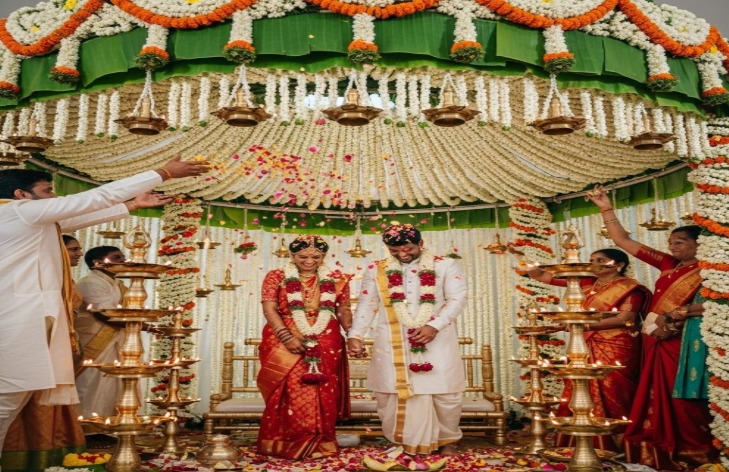
Mangalya Dharanam
During Mangalya Dharanam, the groom ties the Mangalsutra around the bride’s neck at the designated Muhurtham.
Talambralu
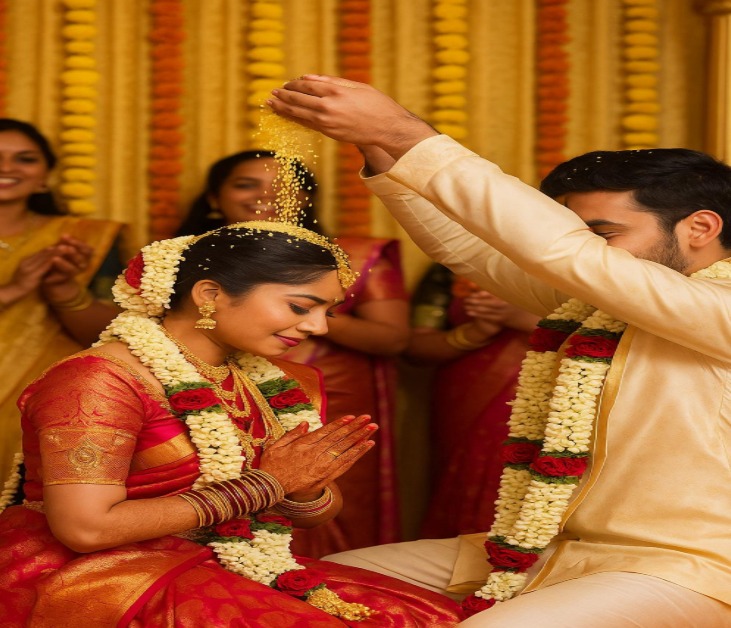
Talambralu is a joyful Telugu wedding tradition where the bride and groom shower rice mixed with turmeric over each other.
Saptapadi
Saptapadi involves the traditional seven steps taken by the couple during the wedding ceremony.
Akshatalu
Akshatalu, or blessed rice, is used during wedding rituals and blessings.
The exact rituals and their sequence may differ according to family and community traditions.
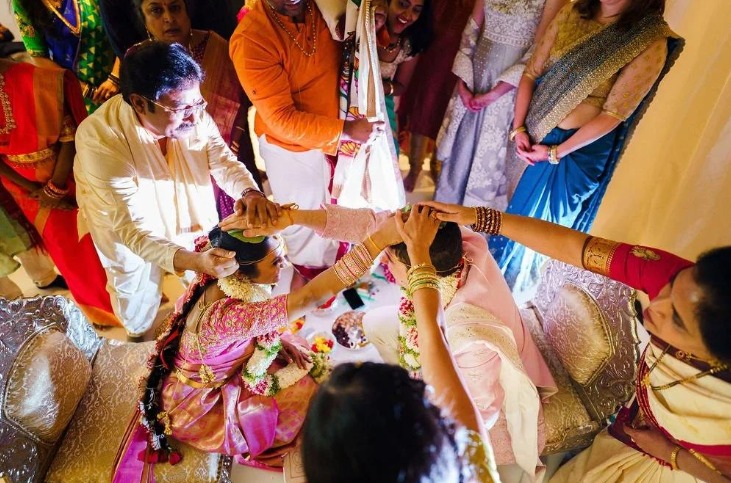
Marriage Muhurtham and Wedding Date: What Is the Difference?
Marriage Muhurtham and the wedding date are related but are not exactly the same.
The wedding date identifies the day on which the wedding takes place.
The Marriage Muhurtham identifies the specific auspicious time during that day when important wedding rituals are performed.
For example:
Wedding Date: 15 November
Marriage Muhurtham: 10:30 AM – 11:45 AM
The actual timing depends on the Panchang calculations for the particular year and wedding location.
How to Plan a Wedding Around the Marriage Muhurtham
Once the Muhurtham has been finalized, families can organize the rest of the wedding schedule around it.
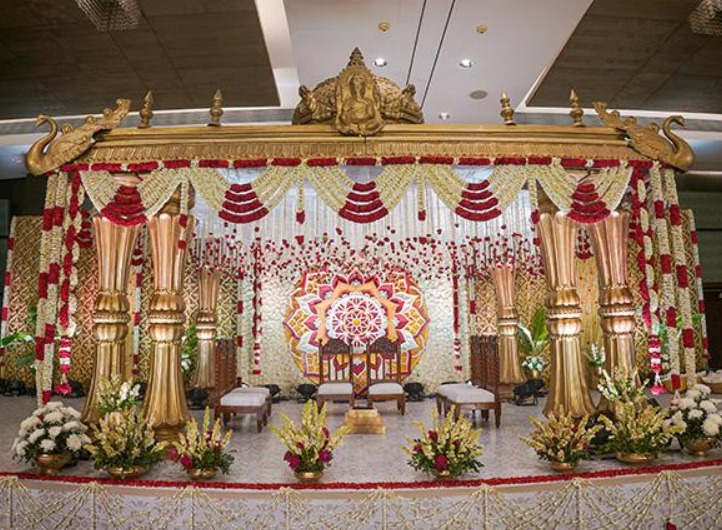
Book the Wedding Venue
Select a venue that provides enough time for the pre-wedding rituals, main Muhurtham, and post-wedding ceremonies.
Coordinate With the Priest
Share the finalized date and time with the priest so that all rituals can be planned accordingly.
Schedule Makeup and Dressing
The bride and groom should have sufficient preparation time before the main Muhurtham.
Coordinate With Photographers
Photographers and videographers should be informed about the exact timing of important rituals.
Inform Family Members
Family members and guests should know the Muhurtham time, especially if the main ceremony takes place early in the morning.
Plan the Reception
If the reception is on the same day, plan it around the main wedding rituals and other traditional ceremonies.
Common Mistakes to Avoid When Choosing Marriage Muhurtham
Choosing a Date Only Because It Is Convenient
A weekend may be convenient for guests, but convenience alone does not determine a traditional Marriage Muhurtham.
Checking Only the Tithi
Tithi is only one Panchang factor. Other elements should also be considered.
Ignoring the Wedding Location
Muhurtham calculations can vary according to geographical location. The date and time should therefore be calculated for the place where the wedding will take place.
Using an Old Wedding Calendar
Marriage Muhurtams change from year to year. A date that was suitable in a previous year should not automatically be considered suitable for another year.
Ignoring Family Traditions
Different communities may follow different rules and customs. Families should consider their own traditions while finalizing the Muhurtham.
Finalizing Vendors Before Confirming the Date
It is generally more convenient to confirm the Marriage Muhurtham before making major wedding arrangements and bookings.
Marriage Muhurtham Planning Checklist
Before finalizing the wedding date, families can use the following checklist:
- Select the preferred wedding period
- Check the Panchang
- Verify Tithi
- Check Nakshatra
- Check Vara
- Check Yoga
- Check Karana
- Check Lagna
- Consider the bride’s birth details if required
- Consider the groom’s birth details if required
- Check regional customs
- Consult the family priest
- Confirm the wedding venue
- Inform important family members
- Coordinate vendors
- Prepare the final wedding schedule
How VedaGayathri Helps With Traditional Wedding Planning
At VedaGayathri, we aim to make traditional Hindu ceremonies easier to understand by providing useful information about Poojas, Muhurtams, festivals, rituals, and auspicious occasions.
For families preparing for marriage, understanding the significance of Marriage Muhurtham can help them organize the wedding ceremony while respecting their traditional customs.
VedaGayathri can also be a useful resource for learning about different wedding-related rituals, Poojas, auspicious dates, and traditional practices.
Whether you are beginning your wedding preparations or looking for information about a specific Hindu ceremony, VedaGayathri provides informative resources to help you understand the traditions behind these important occasions.
Frequently Asked Questions About Marriage Muhurtham
What is Marriage Muhurtham?
Marriage Muhurtham is an auspicious date and time traditionally selected for conducting the main Hindu wedding ceremony.
Is Marriage Muhurtham the same as the wedding date?
No. The wedding date refers to the day of the wedding, while Marriage Muhurtham refers to the specific auspicious time selected for the important wedding rituals.
Which factors are considered for Marriage Muhurtham?
Traditional calculations may consider Tithi, Vara, Nakshatra, Yoga, Karana, Lagna, planetary positions, and in some traditions the birth details of the bride and groom.
Can Marriage Muhurtham be selected without Kundali?
A general Panchang-based Muhurtham can be identified, while some families additionally consider the couple’s Kundalis. The practice varies according to family and regional traditions.
Why is Nakshatra important for Marriage Muhurtham?
Nakshatra represents the lunar constellation and is one of the Panchang elements considered when selecting auspicious timings for traditional ceremonies.
Does Marriage Muhurtham depend on location?
Yes. Muhurtham timings can vary according to geographical location, sunrise, and other astronomical calculations. The timing should therefore be checked for the actual wedding location.
Can the same Muhurtham be used for every wedding?
Not necessarily. The final Muhurtham can depend on the year, location, Panchang, family traditions, and whether personalized horoscope considerations are followed.
How early should Marriage Muhurtham be finalized?
Families often finalize the Muhurtham well before the wedding so that they have enough time to arrange the venue, invitations, priest, decorations, catering, photography, and other services.
Conclusion
Marriage Muhurtham is an important aspect of traditional Hindu wedding planning. It identifies an auspicious date and time for performing the significant rituals associated with the marriage ceremony.
The selection of a Muhurtham may involve several Panchang elements, including Tithi, Nakshatra, Vara, Yoga, Karana, and Lagna. Some families may also consider the birth details and Kundalis of the bride and groom.
Since Marriage Muhurtham can vary according to the year, location, regional customs, and family traditions, it is important to verify the final date and time according to the appropriate Panchang and consult the family priest when required.
With proper planning, families can organize the venue, rituals, guests, vendors, and other wedding arrangements around the selected Muhurtham.
At VedaGayathri, we are committed to helping families understand Hindu traditions, auspicious timings, Poojas, and important ceremonies so they can approach their special occasions with greater knowledge and respect for their cultural traditions.